 Interior of Portree Parish Church Seen from the Gallery |
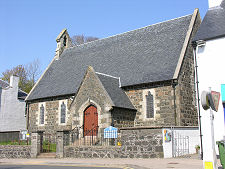
Standing on the north-east side of Portree's Somerled Square overlooking the central car park is Portree Parish Church. Externally it is fairly undistinguished, the main features being a bellcote at the top of the west gable and a porch in the south-east corner.
The church was built as a Free Church in 1854, to a design produced by John Hay of Liverpool. Since then its history has reflected the changes that have taken place in the Church in Scotland more widely. In 1900 it became Portree's United Free Church, before finally becoming part of the Church of Scotland in 1929.
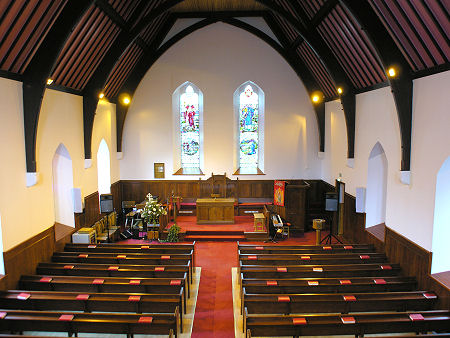
The interior of the church is extremely attractive, and the building has a very welcoming feel. The dark wood of the pews echoes that of the panelling on the lower part of the walls, of the gallery, and of the roof beams.
In most respects the layout of the church is fairly standard, though it is slightly unusual in facing from east to west. The gallery is at the east end of the church, while the "business end" - the communion table, font and pulpit - are at the west end.
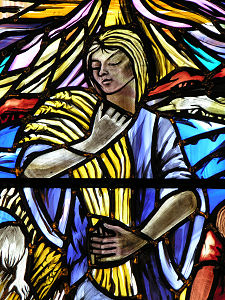
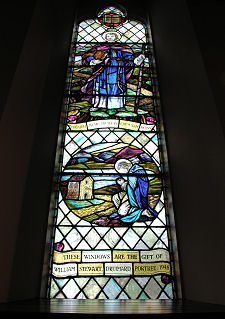
Portree Parish Church has a particularly attractive series of stained glass windows. The two in the west gable, depicting St Columba and someone who might be St Ninian, form a set and were given to the church by William Stewart in 1948. Several others are dedicated to individual congregation members, and the overall effect of a range of styles and subjects is very attractive.
The origins of the church are remembered in a plaque on the inside of the north wall. This notes that: "This church was erected by Miss Louisa MacDonald of Brighton in memory of her father the Right Honourable Sir Archibald MacDonald Baronet. Born at the family seat of Monkstadt, in this island, 13 July 1747. Died 28 May 1826 having filled the offices of Solicitor General, Attorney General, and Lord Chief Baron of the Court of Exchequer in England and a Privy Councillor." The plaque goes on to note that he was buried, with his wife and his mother, in a vault in Kensington Parish Church, London.
Sir Archibald therefore missed seeing the church built in his memory by 28 years and 500 miles: but if he had, he'd probably have been quietly pleased with it.
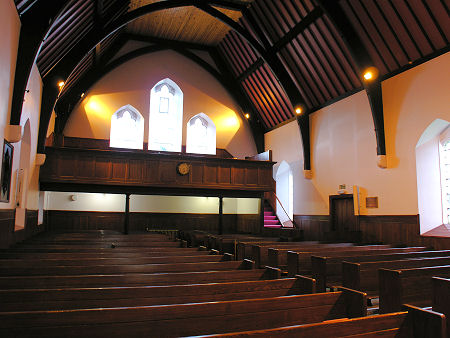 Interior of the Church, Looking Towards the East End |
|
|
|
Visitor InformationView Location on MapGrid Ref: NG 482 437 What3Words Location: ///cascade.projects.paler |
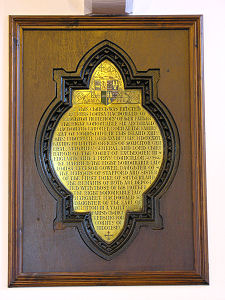 Commemorative Plaque, North Wall |
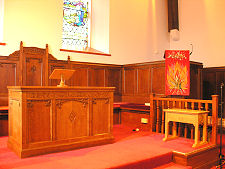 Communion Table |
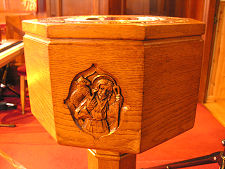 Font |