|
||
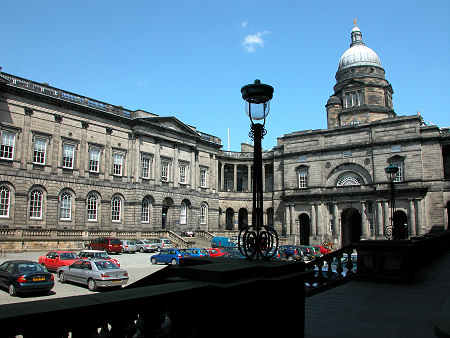 Old College, University of Edinburgh |
The University of Edinburgh lies in the heart of Scotland's capital city. Its buildings, many of considerable historical interest and architectural merit, are spread through the heart of the city, especially in the Old Town. Most are within walking distance of the centre, making this a true city centre university.
There is also a science campus a little to the south of the city centre, and many of the university's halls of residence are gathered together beside Holyrood Park in the shadow of Salisbury Crags. The more outlying facilities have good transport links to central Edinburgh. The university continues to invest in new facilities and grow: one example being the new informatics centre on the edge of the Old Town.
Academically, the University of Edinburgh is highly regarded. This is one of the reasons why its large student body is particularly diverse, with students coming from many parts of the world.
The university is divided into three colleges: the Colleges of Humanities and Social Sciences; of Science and Engineering; and of Medicine and Veterinary Medicine. Within the colleges are 21 "schools" covering particular subject areas. All teaching takes place over two semesters (rather than 3 terms), from late September to just before Christmas, and from mid January to the end of May, with a short Easter vacation. First-year students living outside Edinburgh are offered university accommodation, and Edinburgh is home to a large and thriving student-rental sector.
The Edinburgh University Students' Association provides services, representation and welfare support to matriculated students of the University of Edinburgh. The Edinburgh University Sports Union is the representative body of the 63 Sports Clubs and their members. The Centre for Sport and Exercise includes gyms, sports halls, a swimming pool and other facilities.
History
The founding of the University of Edinburgh can be traced back directly to Robert Reid, Bishop of Orkney and Abbot of Kinloss Abbey. On his death in 1558 he left significant funds for the founding of a seat of learning in Edinburgh, and these formed the basis of the university's endowment. The University was established by a Royal Charter granted by James VI in 1582, making it only the sixth university to be founded in the British Isles, and the fourth in Scotland. Funding came both from the endowment left by Bishop Reid and from the City Council.
In in the 1700s the University of Edinburgh was at the heart of the wide ranging revolution in thinking now known as the Scottish Enlightenment, a revolution that led the French philosopher Voltaire to say "we look to Scotland for all our ideas of civilization". Despite this, until the start of the 1800s, the university had no purpose built buildings, instead occupying a wide variety of rented accommodation. In 1827 this changed with the opening of the Old College, built on South Bridge by the architect William Henry Playfair to plans by Robert Adam.
More new buildings followed, including a new Medical School designed by Robert Rowand Anderson which opened in 1875, and the magnificent McEwan Hall, which was completed in 1880. The university is now also responsible for the oldest purpose-built concert hall in Scotland (and the second oldest in use in the British Isles) St Cecilia's Concert Hall, built for the Edinburgh Musical Society 1763; and in 1889 it opened Teviot House, the oldest purpose built Student Union building anywhere in the world.
The origins of the university library date back to a collection formed in 1580, two years before the university itself was founded. It has grown to become the largest university library in Scotland with over 2 million periodicals, manuscripts, theses, microforms and printed works. It is housed in the main University Library building in George Square, designed by Basil Spence and one of the largest academic library buildings in Europe. There are also a number of more specialised faculty and departmental libraries. In 2011 the previously independent Edinburgh College of Art became part of the university.
Notable People Associated with The University of Edinburgh
|
