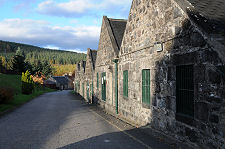
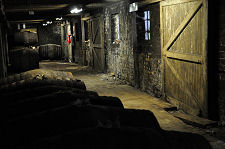
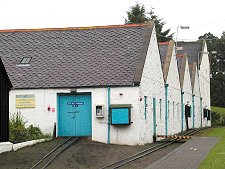
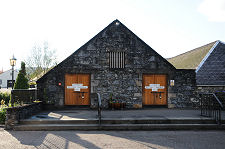
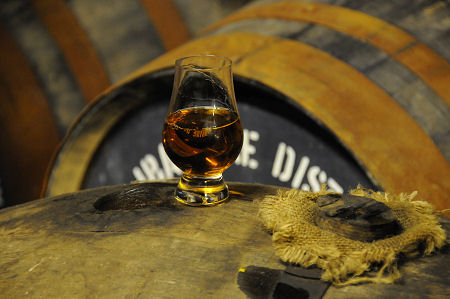
 A Sample of the Product, Tullibardine Distillery |
Estimates vary, but it is often said that around three-quarters of the taste of malt whisky comes not from from the malted barley, the water or (even) the peat used in its initial production, but from the oak casks in which it is placed after distillation to be matured.
The origins of current practice date back to a Royal Commission set up by the Government to decide what could, and could not, be called "Scotch whisky" in 1908. The outcome was legislation passed in 1915 decreeing that in order to be called Scotch whisky, malt (or grain) spirit had to be matured in oak casks for a minimum of three years. This remains the case today.
Trying to mature Scotch whisky in brand new oak casks tends to produce a spirit that has unpleasant flavours. So, bizarre though it sounds to those unfamiliar with the industry, Scottish distillers are completely dependent on oak casks that have first been used to mature another alcoholic drink somewhere else in the world.
As a result Scotland is the destination of a constant flow of empty and dismantled bourbon casks from the USA, sherry and port casks from Spain, and burgundy and claret casks from France, to name just a few. Most casks used in Scotland are American white oak casks which were previously used to mature bourbon: while about a quarter are made of European oak and were previously used to mature sherry or other drinks. It's been estimated that there are 17 million second-hand casks currently in use in Scotland. (Continues below image...)
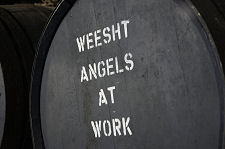
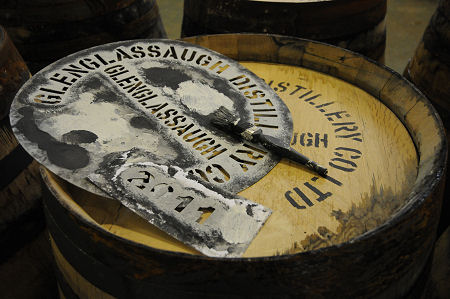 Stencil in Use, Glenglasshaugh Distillery |
Opinions differ, but it is thought that the chemical changes in the maturing whisky, and the tastes it acquires in the cask, are not wholly attributable to anything left in the wood by the alcoholic drink that was previously in the cask. Also very important is whether the oak used is American or European, whether it was originally dried in the open air or in a kiln, and what changes have been made to the wood by the previous occupant of the cask. Bourbon and sherry, for example, affect casks in different ways, and leave different chemical components of the wood available to react with the whisky.
Having said that the previous use of the barrel can also have an important effect in terms of the "finish" or "expression". Whisky matured in a cask previously home to, say, port, takes on some of the character of the port and the result gives an added layer of complexity to the whisky in the cask, and an extra dimension to the range of differences that exist between single malt Scotch whiskies.
Over time the active components of the wood in the cask can be "used up" by the maturation process. "First fill" casks (i.e. casks that have not been used to mature whisky before) are much in demand and can mature spirit more quickly. Second and third fill casks add less to the scotch, and do so more slowly. And while charring the inside of casks can prolong their active life, those older casks still capable of securely holding the liquid tend to be used for grain whisky after two or three fills of malt whisky.
Once the spirit has been put into casks they are moved off to the bonded warehouse. Here the spirit spends the legal minimum of three years of quietly frantic chemical interaction with the wood of the cask before becoming Scotch whisky, and perhaps 10, 12 or more years maturing if it is destined to become single malt whisky.
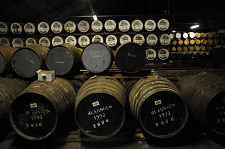
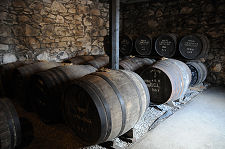
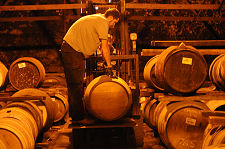
There are three methods of storing casks in warehouses, and some distilleries use more then one. The first is "traditional", in which casks are simply piled up to a height of three layers high and in which moving tends to be done by hand. The second is "racked", in which casks are placed, often by a variant of a fork lift truck, onto racks that in some distilleries are very high. And the third is "palletised"
Bonded warehouses tend to be cool and sometimes damp places. Nonetheless, the wood of the casks is permeable and evaporation of the alcohol does take place. At a rate of about 2% per year of maturation, someone has calculated that the "Angels Share", the evaporated alcohol, amounts to about 150 million bottles per year across Scotland.
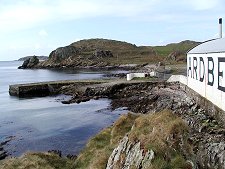
Some whisky, especially that destined for the blenders, is matured in the large bonded-warehouse estates that are found across Lowland Scotland. But many distillers see great benefit, from the point of view of marketing and arguably taste, in following the traditional route of warehousing on site. This matters especially to distillers like Talisker or those on Islay who mature their whisky next to the sea. There are those who challenge the idea that you can taste the effect of this on some of these whiskies: but we like to think we can...
Once the malt whisky has spent its alloted time maturing, it is moved on to the next stage in the process, which for single malt Scotch whiskies means bottling. These days it is the norm for this to take place in centralised bottling plants, though in a few cases it is still done at the distillery.
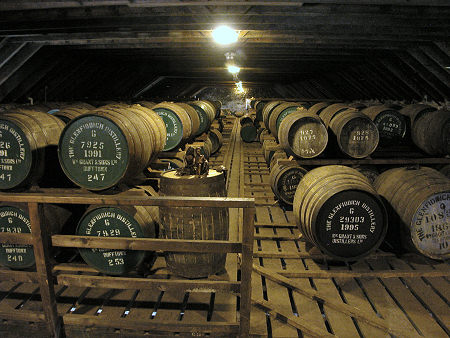 Bonded Warehouse, Glenfiddich Distillery |
|
|
|
Making Malt Whisky: |
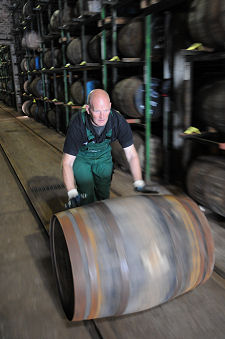 Moving Casks by Hand, Ardbeg |
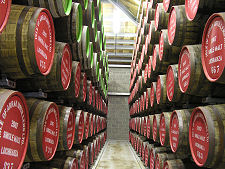 Racked Storage at Isle of Arran |
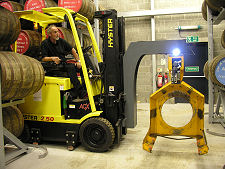 Cask Movement at Isle of Arran |
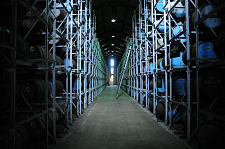 Racked Storage at Glenlivet |
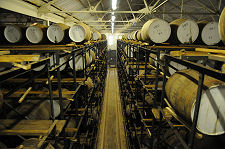 Racked Storage at Glenglasshaugh |
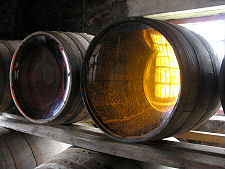 Transparent Ends at Glen Moray |
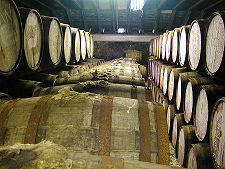 Traditional Storage, Glenmorangie |
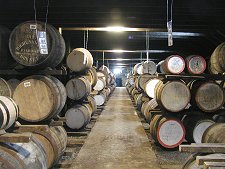 ...and at Highland Park |
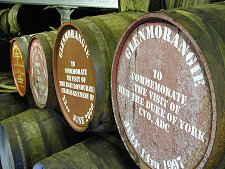 Commemorative Casks, Glenmorangie |