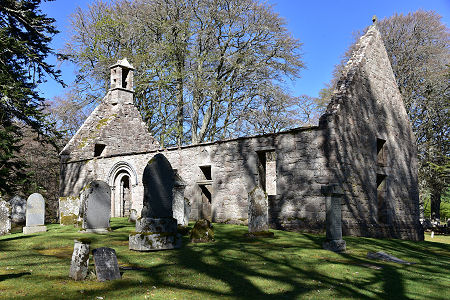
 St Mary's Kirk, Auchindoir |
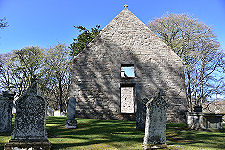
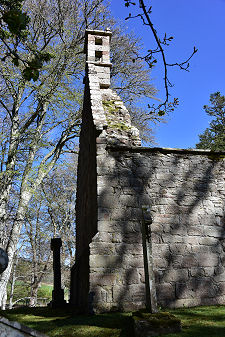
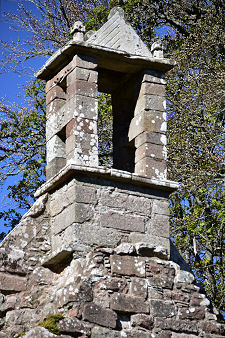
St Mary's Kirk, Auchindoir, is one of Scotland's best preserved medieval parish kirks. It has stood without a roof since the early 1800s, but the stonework of the church itself is remarkably complete.
St Mary's can be found a little under half a mile west along the B9002 from its junction with the A97, between Rhynie and Lumsden. Soon after you turn onto the "B" road, a ruined church appears on your right, which, for the avoidance of doubt, is not St Mary's. This is the Church of Old Auchindoir, which replaced St Mary's and was itself declared redundant in 1990. St Mary's stands on the left of the road a little further on, behind a substantial kirkyard wall. It is accessed via a drive which comes obliquely back from the road to a gate in the west side of the kirkyard wall.
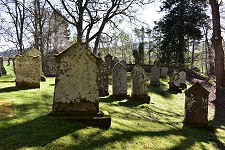
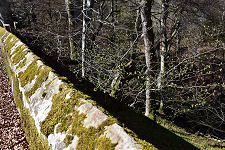
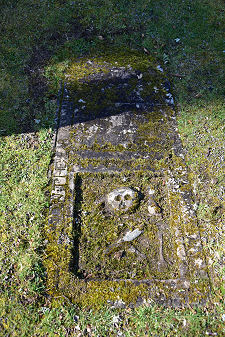
St Mary's stands in a beautiful woodland setting. The kirkyard is home to a range of stones, largely dating from the 1800s. A series of grave slabs on the ground to the east of the kirk are probably older, but have been so thickly colonised by moss it is impossible to tell. The wall on the south-west side of the kirkyard turns it into an irregular shape and a glance over the wall, which is also heavily mossed, reveals why. (Continues below images...)
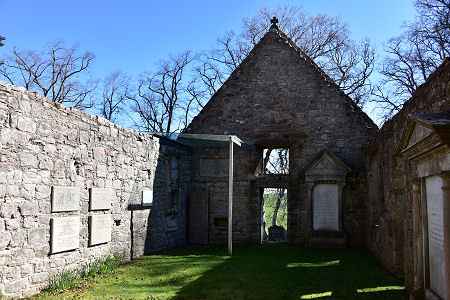 Interior, Looking North-East |
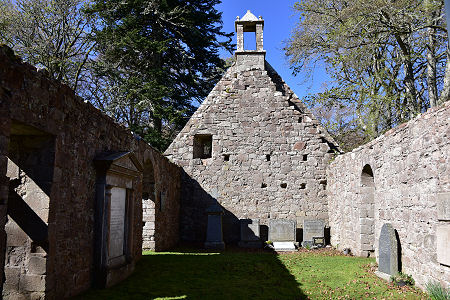 Interior, Looking South-West |
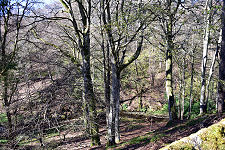
Immediately beyond the wall the ground falls away steeply into the deep ravine formed by the Burn of Craig. This helps explain the location of the church. When St Mary's Kirk was first built in the early 1200s, it served a castle built on a motte overlooking the edge of the ravine to the south-east. Today only the motte remains.
Most of the important features at St Mary's are associated with the structure of the church itself. Perhaps the most obvious is the magnificent Norman-arched doorway in the south-west wall, complete with still very crisp chevron decorations. Inside the kirk the main area of interest is at the north-east corner. Against the north-east gable a grave slab dedicated to "O.L.H.M." and "A.S." and dated 1580 is on display. Early grave slabs often carried only the initials of those they commemorated, though in this case a further clue is given in the form of a large coat of arms. This, and the the arms carried on the plaque inset into the east gable above the grave slab, represents the Gordons of Craig, whose ancestral home is at Craig Castle, half a mile or so to the west.
Another fascinating feature is the highly decorated rectangular niche in the wall forming the Sacrament House, inserted into what had previously been a lancet window in the early 1500s. This would originally have had wooden doors and was used to store the Blessed Sacrament, the bread and wine that formed an important part of the services.
The church at Auchindoir is first mentioned in 1236 and was dedicated to the Blessed Virgin or St Mary Blessed Virgin or St Mary. It was associated with the original castle to the south-east, and with the Well of Our Lady or St Mary's Well, a holy well a short distance to the west of the church which gained a reputation for curing toothache.
In 1514 the church was elevated to become a prebend for King's College, Aberdeen (in other words, its income helped support one of the Canons there). This was when the Sacrament House was probably inserted. The church survived the Reformation to become a Parish Kirk, and was extensively remodelled in the 1600s. The walls of the kirkyard were added in the 1700s, and St Mary's fell out of use when the Church of Old Auchindoir was built to serve the parish in 1810.
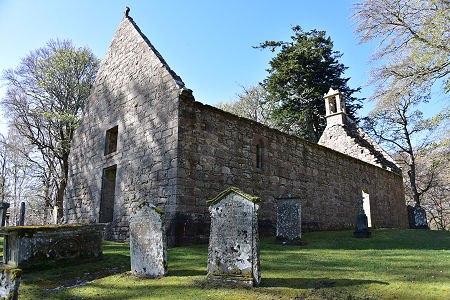 St Mary's Kirk from the North |
|
|
|
Visitor Informationwww.historicenvironment.scotHES: Kirk Web Page View Location on Map Grid Ref: NJ 478 246 What3Words Location: ///lands.calms.dives |
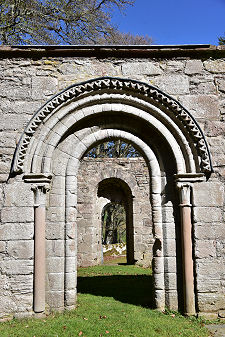 Arched Doorway in South-East Wall |
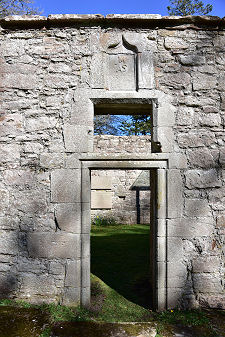 Second Doorway in South-East Wall |
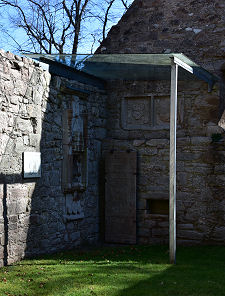 Shelter in North-West Corner |
 Coats of Arms, One Dated 1557 |
 Grave Slab Dated 1580 |
 The Sacrament House |