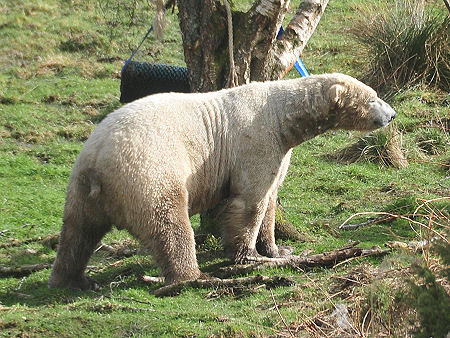
 Arktos, One of the Male Polar Bears |
From Kingussie to Aviemore the "new" A9, built during the 1980s, runs closely parallel to the line of the older A9, now renumbered as the B9152. The old road has a lot to offer, being both much quieter and more interesting than the road that replaced it. Two miles south-west of Kincraig, a junction on this old road leads you underneath the new A9 to one of the Highlands' major visitor attractions, the Highland Wildlife Park.
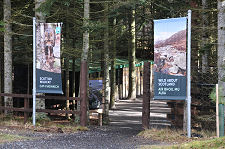
The Highland Wildlife Park occupies a very large site within what is effectively a bowl set into the rising ground on the north side of the valley of the River Spey. It is easy to overlook entirely if you stick to the main A9, so its scale comes as something of a surprise. The park is very roughly circular in shape and comprises three main areas. The first is the entrance reserve, which you drive through after passing the gate kiosks. The second is a large "walk-round area" around the visitor centre and car parks. This has many of the elements of a traditional zoo, but without any of the space constraints. And the third is the main reserve, which you drive around following a loop of road which in places runs along the edge of the "walk-round area" allowing a number of species to be viewed from either area, or from both.
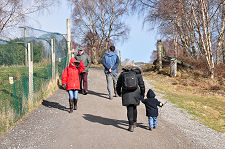
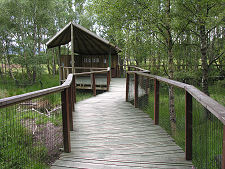
Cyclists and walkers are collected from the gate kiosk by a patrol vehicle and transported to the visitor centre, so it is possible to appreciate much of the park without your own car. Disabled visitors will find that much of the "walk-around area" is wheelchair accessible, with the parts that are not being clearly marked on the map in the guide issued to visitors on arrival. Some otherwise inaccessible parts of the "walk-around area" can be viewed by disabled visitors from their own cars. Disabled parking is provided at the visitor centre and there are adapted toilets. There is an excellent "Information for Visitors with Disabilities" leaflet that can be downloaded from the park's website, linked from this page. (Continues below image...)
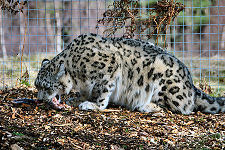
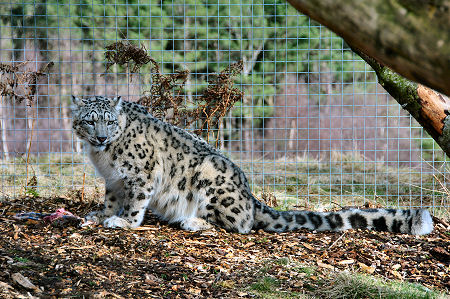 Chan, the Male Snow Leopard |
The Highland Wildlife Park opened in 1972, and since 1986 it has been owned by the Royal Zoological Society of Scotland, which also owns Edinburgh Zoo. For much of its life its role was to focus on Scottish wildlife, both past and present, ranging from Wolves to Red Foxes and including both wild and domesticated animals.
Since the beginning of 2007 the park's remit has expanded dramatically, to include species, especially endangered species, native to tundra and mountainous habitats in many different parts of the world. The result has been to allow the park to work much more closely with Edinburgh Zoo and to offer visitors the chance to view a much wider range of species in this remarkably beautiful setting.
The heart of the park is the visitor centre. Here you can find the Antlers Coffee Shop serving a range of meals, snacks and drinks, and the Wildthings Gift Shop, which carries a range of books and gifts. This area is also home to the park offices and an education centre.
The "walk-round area" surrounds the visitor centre and the different elements are reached by paths leading from it. The Highland Wildlife park continues to evolve over time, so the description that follows is simply a snapshot.
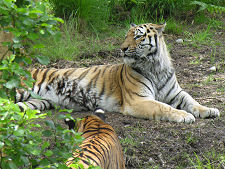
The excellent map given to all visitors on arrival allows you to explore at your own pace and to seek out the animals that most appeal to you. We tackled the "walk-round area" in a roughly clockwise direction from the visitor centre. Walking to the domain of the female polar bear, on the far western side of the park, took us past the Amur tigers, vicunas and musk oxen, as well as the Arctic foxes, one of whom was putting on a "seriously cute" act for visitors' cameras. The female polar bear was nowhere to be seen, but that's the thing about wild animals, even in captivity they have their lives to lead too, and are not just there for the entertainment of visitors.
The main circular path through the "walk-round area" heads steadily uphill from the Arctic foxes to reach a viewpoint at the highest point within this part of the park. From here you can see much of the area it covers and this is a particularly good spot from which to appreciate the layout and scale of the main reserve. For us the highlight of the upper part of the park were the beautiful snow leopards. Carrying on takes you downhill, and around to the enclosure of the two male polar bears. One of them did put in an appearance during our visit and even at a distance it is possible to appreciate just what amazing creatures they are.
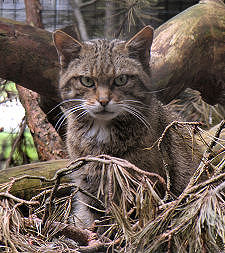
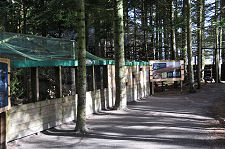
On the other side of the main car park is a forested area in which you find enclosures housing the Scottish wildcats. At first sight these seem very like domestic cats, and interbreeding with domestic casts is one reason why there are now thought to be very few left in the wild in Scotland. But look a little closer and they do have quite distinctive markings and tails, and they tend to be larger than domestic cats. They also have a "don't mess with me" expression and attitude which is fascinating. Nearby is a viewing area for red squirrels, which come in from the surrounding woodland to feed.
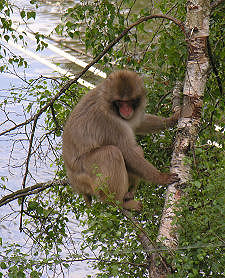
Walking to another viewpoint, a little to the east of the first, takes you past the European wolves and European forest reindeer. Back at the visitor centre you can enjoy refreshments while viewing the activities of the snow monkeys. These Japanese macaques enjoy a home complete with an island in a lake they can reach either over a rope bridge or, as some are happy to demonstrate, swimming.
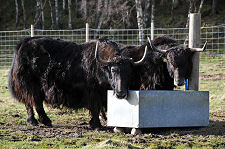
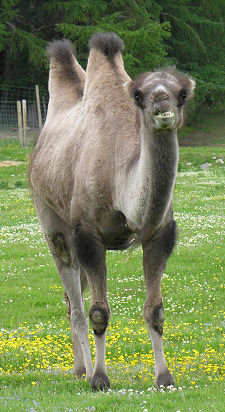
As you drive around the main reserve, animals you are likely to encounter include herds of red deer, which are native to the surrounding mountains; as well as European bison which became extinct in the wild in 1919; and Przewalski's horse, the only true living wild horses, which are also sadly extinct in the wild. In the entrance enclosure the yaks vie for attention with the bactrian camels, which seemed nearly as interested in the passing cars as the occupants of the cars did in them. Just don't let one hear you calling it ugly...
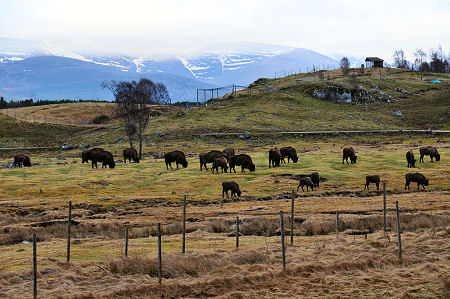 European Bisons and Snowy Mountains |
|
|
|
Visitor InformationWildlife Park WebsiteView Location on Map. Kincraig, Kingussie, PH21 1NL. Grid Ref: NH 803 038 What3Words Location: ///epic.cubic.mull |
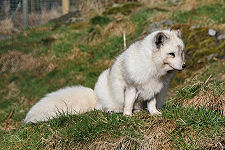 Arctic Fox |
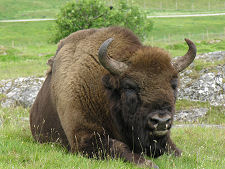 European Bison |
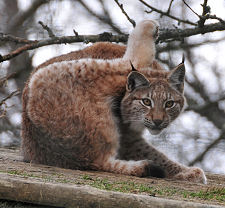 Lynx |
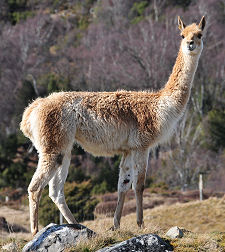 Vicuna |
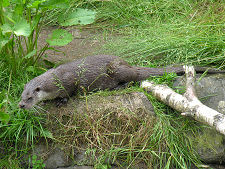 Otter |
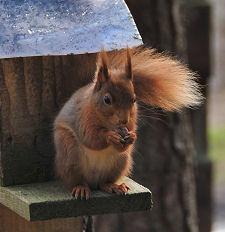 Red Squirrel |
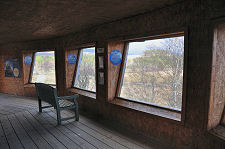 Polar Bear Viewing Area |
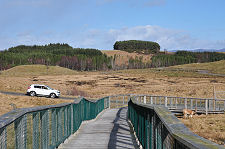 Walkway |
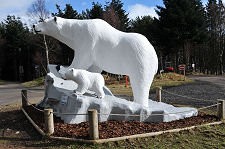 Car Park Entrance |
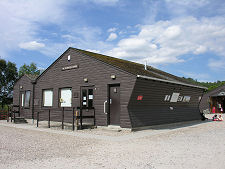 Visitor Centre |
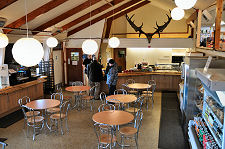 Cafe |